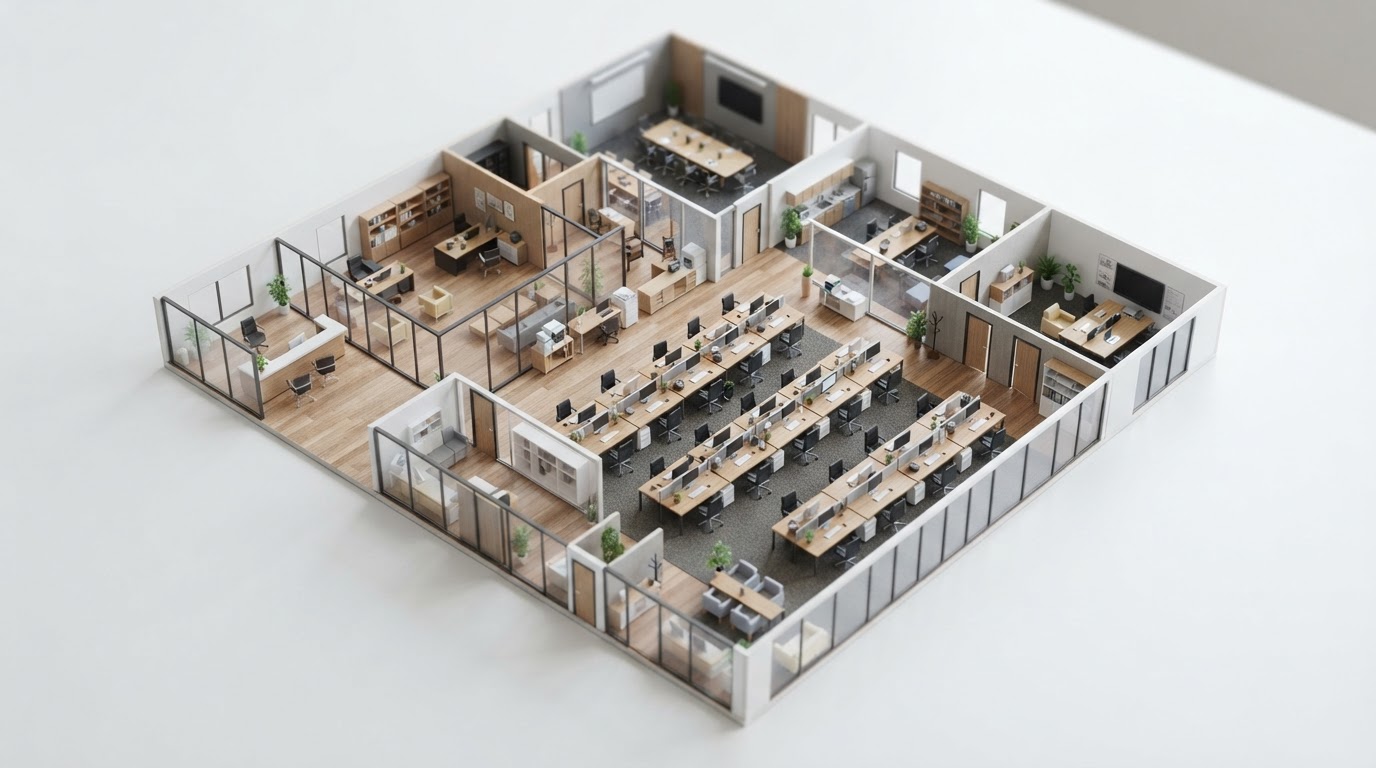

Site selection is too often treated as a real estate transaction when it is, in fact, a strategic and financial decision with a horizon of a decade or more. The rent is only the most visible cost; the total cost of occupancy includes far more, and getting it wrong compounds quietly over the life of a lease — long after the team that chose the building has moved on.
The framing matters because it determines who makes the decision and how. A site selection framed as a real estate transaction is made by facilities, evaluated on rent, and optimized for the tour. A site selection framed as a financial decision is made by leadership, evaluated on total cost and strategic fit, and optimized for the term. The same building, evaluated differently, produces a very different decision.
The costs beyond the rent
Rent is the number everyone negotiates, and it is often the smallest part of what the space actually costs. The total cost of occupancy includes a set of expenses that are less visible but no less real, and that compound over the entire lease term.
- Fit-out and build-out — the one-time cost of making the space usable, often a significant capital expense that is amortized but rarely compared across options.
- Operating expenses and common-area charges that escalate annually, often faster than the base rent.
- Commuting and talent access — the cost of a location your workforce can't reach, measured in turnover and unfilled roles.
- Flexibility — the cost of being locked into space you can't grow into or out of, paid in sublease losses or constrained operations.
- Productivity — the cost of a space that doesn't support the work, paid in collaboration friction and concentration loss.
Evaluate location against the business, not the building
A beautiful building in the wrong location is still the wrong location. Site selection should start with the business question — where does the workforce live, where do clients gather, what does the operation need — and only then narrow to buildings. Reverse the order and you will optimize for the tour and regret it for the term.
The business question has several dimensions, and each carries a financial implication that the rent comparison misses entirely.
- 1Talent — where does the current workforce live, and where will the next hires come from? A location that loses the talent pool loses the people, and the cost of that is measured in turnover.
- 2Clients — where do clients and partners need to reach you? A location that adds friction to client interaction adds cost to the revenue side, not just the cost side.
- 3Operations — what does the work require, in terms of space, power, connectivity, and access? A building that doesn't support the operation is a discount that isn't.
- 4Growth — can the space absorb the headcount and activity the plan anticipates, or will it constrain it? A space that caps growth is a strategic cost, not a real estate one.
The financial model that should drive it
A site selection driven by finance builds a total-cost-of-occupancy model for each option, over the full lease term, including fit-out, escalation, and the operational implications. The model makes the trade-offs visible: the cheaper rent with the expensive build-out, the convenient location with the escalating operating costs, the flexible lease with the premium price. Without the model, the decision is made on the visible number and the invisible costs are discovered later.
The model also makes the negotiation smarter. When you know the total cost of each option, you know which concessions actually matter — a free build-out may be worth more than a rent reduction, a cap on operating escalations may be worth more than a shorter term. The negotiation optimizes the right variable because the model has already identified it.
Why it belongs in management consulting
Site selection sits at the intersection of real estate, finance, operations, and strategy — which is why it belongs in general management consulting rather than pure real estate advisory. A site decision made by real estate alone optimizes the rent. A site decision made with the integrated view optimizes the business. The difference, over a ten-year term, is often the difference between a location that supports the organization and one that constrains it.
“The rent is what you pay per month. The cost of occupancy is what you pay over the term. The strategic fit is what you pay — or gain — for the decade. Site selection is a decision about all three, not just the first.